Saturday, December 28, 2013

A place in Hamilton for Mandela

  • Article rank 
  • 23 Dec 2013
  • The Hamilton Spectator
  • JAHAN ZEB | A15
A place in Hamilton for Mandela
It is true that Nelson Mandela is the son of Africa. The African community of Hamilton proudly shared with other Hamiltonians the opportunity to celebrate Mandela’s life on a cold and stormy Sunday Dec. 15.
Mandela was a universal leader who belongs to not only Africa but the entire world, irrespective of colour, religion, sect, race or class. The celebration was warm. There were plenty of tears, joy, dances, singing and drumming. The participation in the event was so broad — it included people from every continent — that one could believe right away he belonged to the entire world.
Mandela introduced our world to Ubuntu — an African way of life of humanism that reaches across inter and intra community divisions, whether ethnic, racial, communal, political, religious or other. Ubuntu is in absolute contrast to our Western retributive justice system of punishment with a purpose of relationship and community building. Ubuntu is forgiveness and put perpetrators back into the community. Mandela brought South Africa into unity and we can learn from many of his lessons.
It is heartening that the entire world feels proud to live the legacy of Mandela. Ziauddin Yousafzai, father of the UN education ambassador, young Malala Yousafzai of Pakistan who was shot by the Taliban, told me Malala considers Mandela “her leader” and wants to follow in his footsteps to empower more than 600 million girls through education. This is the charisma of Mandela. We in Hamilton can also take in the message of Mandela’s life and struggle and transform conflicts among our peers, families, classrooms, and workplaces into relationships.
I have received tremendous support from many community leaders, faith groups, students, and civil society organizations to rename either King or Main street in the name of Mandela and declare Hamilton a Peace City. I am pleased that Mayor Bob Bratina, Hamilton Police Chief DeCair and mayoral candidate Brain McHattie have publicly endorsed the renaming idea.
The people of Hamilton can, I hope, make this a true peace city in Canada and the world; a city in which Mahatma Gandhi, the prophet of non-violence, is remembered and honoured with a statue beside City Hall. 
Jahan Zeb is co-ordinator with Gandhi Peace Festival, a project of McMaster University and Hamilton community. jahanzebca@gmail.com

Saturday, October 12, 2013

Reflections


 Reflections

Oct 11 2013
Malala is challenging both the global North and the forces of dogma and  darkness at the same time. She says drones and the use of force are counterproductive. Her message is investment in children education. She strives for enlightenment, equality of men and women  and equity and fairness.

Oct 12 2013
Malala's message is very simple to Taliban and their apologist: Come to dialogue for the  sake of peace, education and prosperity.  How Malala's message be internalized by children and youth in conflict zones?


Reflections

Malala has shown SOFT image of Pashtuns to the world Nobel4Malala will make it more prophetic

Malala carries a torch for those who would banish the dark forces of violence & repression

liberty, & reason agnst dogma&darknesssub-consciousness. 

Hosted Ziauddin yesterday @McMasterU

I found Malala modest, thoughtful, original, caring and full of indigenous Pashtun wisdom during my meeting with her in New York City on Sunday Oct 6, 2013

We need to reconstruct our collective memory&narrative to encounter the lie of d forces of darkness


#Malala has become shining star of the global stars -
Prady mahshar day - prady ghobal day Halta Hum Za Maram -Dalta hum za Mraum [is part of #Malala Book]

My family & I had d honour meeting iconic leader of our times #Malala "cannot wait to finish #Malala Book" Says my little son
Pashtun culture, believing that it teaches patience, peace and religious tolerance
Perpetrators need to ask for forgiveness from #Pashtuns of #AfPak- A #TRC need to expose the pple of darkness
#Malala is a week away 2 win her well-deserved Noble Prize 2 save humanity,
#Malala father - Ziauddin is a prolific speaker. Appeals to hearts &


#Peshawar is bathed in its children blood Wake-up & defeat d forces of darkness

They NEVER wept,the men of my city- they do now in the cruel & unwise state of #Pakistan


Pashtun will NEVER forget the VIOLENCE brought by the people of darkness but CAN FORGIVE for sustained peace


Silence is the name of oppression!

Sta Pa Na RaTLo Za KhudayGo Ka KhaPa Yam - Kho De StoRo Ta De Der BeGa KaCha KRam -Abdullah Jan Maghmom (MarChaKay) @KhanBehroz @haikakar

Sunday, August 25, 2013

Debate or Dialogue?

I think we are taking rigid and even stubborn positions to defend our  'opinions and/or assumptions' re our point of view on culture, politics, or simply, what to eat/drink/ wear . We consider our opinions the ultimate 'truth' .   Sometimes, we associate our 'identities' with our 'opinions' and if they are  challenged, we feel 'inferior, embarrassed and ashamed'  and go into endless circles of debates. We mobilize our friends to find counter arguments to create a win-lose situation. We try to win and feel our opponent  'defeated' and 'stupid'. And the discussion ends with purposeless self-joy and entrancement or shamefulness for our opponents or the vice-versa.
I don't argue that discourse, discussion and debate are not useful  'a la' situations. I wish we come out of the debating mode and initiate a purposeful 'dialogue' among ourselves to reach a shared meaning of oneness  and unity.
Dase Wkhat ba Kala Rashi,
Che Zamung Jehaz ba Hum vee
...............................
Za Ba Khpal Jarnel Pase Yam

Pa Dushman ba Daao Kawal wee

Thursday, August 15, 2013

Malala’s Quest for Peace and Education


Malala’s Quest for Peace and Education

MALALA

Andrew Burton,Getty Images
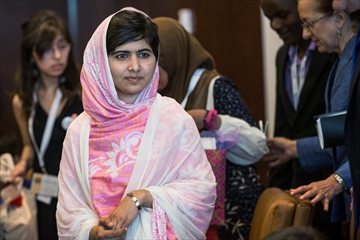
Malala Yousafzai, the Pakistani advocate for girls education, attended United Nations Youth Assembly last month.
ByJahan Zeb 
Millions of the world's peaceful and hopeful people — and especially the Pashtun nation, home of Malala Yousafzai — were jubilant when she took the stage of UN General Assembly to address the world on her 16th birthday on July 12.
A video presentation of her speech at the UN will be part of the Gandhi Peace Festival at Hamilton City Hall on Oct. 5 at 10 a.m. There will also be an interactive conversation about Malala's Quest for Peace and Education, with her native community members at the free festival.
Malala's confidence, thoughtfulness and soft-spoken words at the UN provided the world a rare opportunity to internalize the message of education and peace.
But indeed it was the rarest occasion for Pashtuns to be represented by Malala in the highest forum in the world. Until now most of the invaders, such as Zahir-ud-din Babur, Sir Winston Churchill and Sir Olaf Caroe, have told the story of Pashtuns for their empires' hegemonic designs and Pashtuns have been stereotyped as a marshal race who loves wars. But time provided an opportunity to Malala to represent the true image of Pashtuns in the comity of nations.
Pashtunwali, the way of life of Pashtuns, is an unwritten constitution that provides the right of expression though cultural institutions such as hujra and jirga. The Pashtuns are normal human beings who submit to dialogue and respect for treaties; have forgiveness, and who protect children, women, and elderly in feuds and wars. This lifestyle was practised centuries before the Universal Declaration of Human Rights of 1948 and the Geneva Convention of 1949.
Unfortunately, the West did not pay attention to Pashtuns' story while creating new states and contemporary societies. The West ignored the philosophy of nonviolence and the struggle for freedom of Bacha Khan due to their Cold War rivalry. The West used Pashtuns as cannon fodder in this rivalry and their land was used as a buffer zone between Western sphere of influence and Moscow. This mindset is slowly changing because the indigenous Pashtun people have shown prolonged non-violent resistance and resilience for peace.
Malala's struggle is a continuation of the nonviolence philosophy of Bacha Khan which is based on the teachings of Buddhism and Islamic 'sageness' — the basic principles of Pashtunwali and indigenous egalitarian Pashtun society that is fully aligned with universal humanism and bonding.
This is what Malala said: "Even if there was a gun in my hand and he (Talib) was standing in front of me, I would not shoot him. This is the compassion I have learned from Mohamed, the prophet of mercy, Jesus Christ and Lord Buddha. This is the legacy of change I have inherited from Martin Luther King, Nelson Mandela and Mohammed Ali Jinnah. This is the philosophy of nonviolence that I have learned from Gandhi, Bacha Khan and Mother Teresa. And this is the forgiveness that I have learned from my father and from my mother. This is what my soul is telling me: be peaceful and love everyone."
Malala boldly deconstructed the discourse of Taliban and their apologists with compassion by saying: "We realize the importance of our voice when we are silenced. In the same way, when we were in Swat, the north of Pakistan, we realized the importance of pens and books when we saw the guns. The wise saying: 'The pen is mightier than the sword' — it is true. The extremists are afraid of books and pens. The power of education frightens them. They are afraid of women. The power of the voice of women frightens them. They think that God is a tiny, little conservative being who would point guns at people's heads just for going to school. These terrorists are misusing the name of Islam for their own personal benefit. Pashtuns want education for their daughters and sons. Peace is a necessity for education (and prosperity). In many parts of the world, especially Pakistan and Afghanistan, terrorism, war and conflicts stop children from going to schools. We are really tired of these wars."
Today, over 50 million Pashtuns are tired of an imposed war. They are resisting the worst form of armed violence, and social and political instability with the nonviolence weapon that Baacha Khan had given to them in 1930. Malala reinvigorated this struggle, which is not only resisting militancy in the Af-Pak region, but also for broader regional peace and global security.
The regional states, civil society, and the international community, therefore, need to study and analyze the lives and struggle of Pashtuns and address the root causes of war theatre being played on Pashtuns' land. They need to create dialogue for peace-building by organizing conversation forums, seminars and conferences to defeat extremism and bring peace to Af-Pak and the region.
Hollywood and Bollywood need to make films on the life and struggle of Bacha Khan and Malala's legacy to advance the universal peace agenda that offers a profound message of hope in these increasingly troubled times.
The people and governments of the region, especially Af-Pak and India, need to initiate dialogue to resolve their disputes peacefully. They need to include peace education in their national curricula and to highlight positive role models such as Malala, Bacha Khan, Gandhi, Mandela, King and Jinah to give hope to present and future generations.
They need to find common bonds using the goodwill of Malala's stature to work toward free trade and shared markets to educate their nations and create conditions for respectful dialogue, human security, poverty reduction, access to education, sustainable local markets, and good governance for the millions of people.
Jahan Zeb is working with Gandhi Peace Festival, a project of McMaster University and Hamilton community.jahanzebca@gmail.com
-
Comments on the article in The Hamilton Spectator;
-----


Very wise words.
~  Reverend Sue-Ann Ward - Oakville
-----------------
A lovely and inspiring article.
~  Prof. Joanna S Barbara - New Zealand
-----------------
I read your article and I congratulate you for the extremely nice piece....Thanks for the good article.
~Behroz Khan - Voice of America 
-----------------
Nicely written Article.  All the best.
~ Prof. Lowell Ewert - Director of the Peace and Conflict Studies Program, University of Waterloo, Canada
-----------------
This is an important story, with much about cause-and-effect, self-will versus listening to the "other" in advance of self-serving activities, and the importance of each citizen. And there must be far, far more than nonviolence -- the pre decision to reject violence. People must cross lines and engage, together becoming artisans of communication, empathy, and shared creativity.
~Libby and Len Traubman,  Founders of Jewish-Palestinian Living Room Dialogue Group, US
-----------------
I enjoyed reading your article in the Spec today. It is timely and valuable.
~Sadhna Jayatunge - Community Leader - Hamilton
-----------------
... You have good substance in this article here and is beautifully written  As for Malala anything I say would be less...she is truly an angel !!
~Babina Kharel  Graduate Student MPACS - Nepal
-----------------
 Good article Jahan. Well written and providing clarification about Pashtun aspirations.
~Dr Khursheed Ahmed  Gandhi Peace Festival Hamilton Canada
----------------
 I found it [your Article in The Hamilton Spectator] very insightful and useful on a number of levels. I am particularly interested in your comments about the various resources that the Pashtun people have had (and continue to have despite the challenges that you list) for fostering dialogue, nonviolence, and egalitarianism - aspects that speak to a universal humanism as you note.....I  highly encourage you to write more. It is very hard for people to get beyond the colonial stereotypes of Pashtun culture and people because all they get is the usual media, think tank and academic coverage. 
~ Narendran Kumarakulasingam PhD, University of Waterloo, Canada and American University, Washington DC
-----------------
~I am impressed!
~Dr Neil Arya - London
-----------------

 Link to the article

Friday, August 2, 2013

Sustained Dialogue at the University of Waterloo

Sustained Dialogue (SD) are the relationship building processes that enable students across universities to address emerging issues. Issues may include identity, racism, civil rights, sexism, transphobia, islamophobia class, imperialism, indigenous sovereignty, decolonization, dictatorship, environmental degradation, poverty etc.

If you are interested in co-create supportive systems and co-facilitate students engagement and their connection with the activists, community groups, and the local and global civil society to identify and address such issues and provide leadership to build and enhance students and community understanding of issues, build your leadership capacity and contribute to others, please share any suggestions re how we can launch SD group at uWaterloo?

Tuesday, July 16, 2013

Drone Attacks: A Challenge for Pakistan's New Government

Drone Attacks: A Challenge for Pakistan's New Government

The newly elected government in Pakistan has spoken of halting the contentious unmanned US aerial vehicle (UAV) or drone attacks on Pakistani soil. However, these hopes were delivered a blow in recent weeks, when the US targeted al-Qaeda and Taliban fighters with a drone strike in the North Waziristan Agency of the Federal Administered Tribal Area (FATA), killing six suspected militants including “some high value targets” . The government of Pakistan immediately summoned the US envoy to Pakistan in order to protest the strike. Imran Khan, of the Pakistan Tehreek-e-Insaf (PTI) or justice party, has since pushed for a debate in the National Assembly of Pakistan on the issue of drones, calling for military action against US drones operating in Pakistani airspace. 
Since 18 June 2004, drone strikes have killed several senior ranking Taliban and al-Qaeda leaders, including Nek Mohammad, Baitullah Mehsud, Baddrudin Haqqani, Mullah Nazir, Maulvi Dadullah, Wali-ur-Rehman, Abu Kasha Al-Iraqi and Saleh Al-Turki.  But it has also killed, according to varying and often disputed estimates, scores of civilians.
Last month, President Barack Obama delivered a speech on the future for the U.S. war against terrorism at the National Defense University in Washington, DC in which he addressed the use of drones. In his speech, President Obama stated, "We [the US] only target al-Qaeda and its associated forces...our actions are bound by consultations with partners, and respect for state sovereignty.... we act against terrorists who pose a continuing and imminent threat to the American people, and when there are no other governments capable of effectively addressing the threat."  He continued, "It is a hard fact that U.S. strikes have resulted in civilian casualties, a risk that exists in all wars. For the families of those civilians, no words or legal construct can justify their loss.” The U.S. President made no mention of ending or curtailing the controversial practice of "signature" strikes, which target groups of men based on behaviour patterns associated with terrorist activity, as opposed to “personality” strikes, which target specific individuals with verifiable links to terrorist organizations.

Deaths caused by drone attacks, whether civilian or militant, are difficult to accurately assess, as different groups offer varying estimates.

Deaths caused by drone attacks, whether civilian or militant, are difficult to accurately assess, as different groups offer varying estimates. The New America Foundation estimatesthat since 2004 there have been 357 US drone strikes, killing an estimated 2,021–3,350 people, including 258-307 civilians, 1,567-2,713 militants and 196-330 unknowns. The accuracy of killing al-Qaeda or Taliban militants is estimated to be between 84-95 percent. Conversely, the PTI has pegged the number of civilian deaths at more than 3,000, although without providing supporting evidence. President Obama disputes the assessment of NGO reports on civilian death tolls, but fails himself to offer clear contrary evidence. The same is the case with the Government of Pakistan, which has not made their recorded data public. Pakistan has also blocked physical access to the FATA, making it inaccessible to national and international media as well as rights-based advocacy and civil society groups. As such, the exact death toll of drone attacks in recent years is difficult to determine.
With an area of 27,000 square kilometers, including a 600-kilometer disputed border with Afghanistan, the seven million people living in Pakistan’s FATA are the most hard-hit victims of the war on terror.  Unfortunately, as S. Iftikhar Mursed writes, "the tragedy of Pakistan is that in this age of realism, its leaders are never realistic. They are creatures of absurd emotions, the consequences of which can be catastrophic." Interestingly, Zmarak Yousefzai, who was born and raised in FATA and practices national security litigation in Washington, DC, writes that the residents of FATA, who have witnessed the impact of drone attacks first hand, are less opposed to the use of drones than the rest of the population of Pakistan.  
To better understand this reasoning, I asked Yousafazi in a phone interview why he believed FATA residents to be in favour of drones. He replied:
"If you are a local Pashtun, why won't you prefer drones? You have foreigners that have come to your land; they have taken over your land, home and village. You are a displaced person. And after all you are displaced, these thugs then invite drone attacks. Now, if there are no drones, you have three alternatives? (1) let the Taliban operate with impunity; (2) allow the U.S. to invade the border areas; or (3) allow Pakistani army to start operations. All the three options will cause more harm, civilian deaths and destructions"
Pir Zubair Shah, who was born and raised in Waziristan FATA and is a Fellow at the Council on Foreign Relations, shares a similar opinion to Yousafazi. I reached him in New York for a phone interview. He explains:
"FATA's residents favour drones because of their high precision and accuracy of killing Al Qaeda and Taliban leaders who have killed over 1,000 elders and have distorted the local egalitarian culture and traditions of Pashtuns (Pashtunwali) with Arab and many other foreign cultures. Above all, drones don't displace people while over four million FATA residents have been displaced as a result of Pakistan Army's operations since 2004. "
The ongoing honeymoon period being enjoyed by Pakistan's new civilian government presents a good opportunity to abolish the colonial-era Frontier Crimes Regulation legislation and extend the central government’s writ into FATA. This would help to advance good governance and key reforms to the security sector and beyond in the FATA. The time is ripe for PM Nawaz Sharif to pacify militants through dialogue, conciliation, and political dialogue, while urging the US to halt drones attacks without giving space to the jingoistic opposition's rhetoric of shooting them down.Pakistan's mainstream political leaders, as well as drone critics in the West, such as organizations like Code Pink, would do well to consult those most affected on the ground. Instead they have been concerned more with political point scoring than the goal of advancing peace, security and development in the FATA.

Jahan Zeb is a Research and Communications Intern with the Security Governance Group.

Thursday, July 11, 2013

Bohm on Dialogue

David Bohm on Dialogue 

Dialogue is always testing ground for the limits of assumed knowledge - offers the possibility of entirely new order of communication and relathionship with ourselves, our fellows and the world we inhibit.  

Bohm's work on dialogue is deep and thought provoking. It provides a freely-flowing space for conversation and dialogue where  participants attempt to reach a common understanding, experiencing everyone's point of view fully, equally in a non judgemental way. He advocates full inclusivity to bring collective meaning to the sense of discourse. He advocates not to judge assumptions and opinions of self and others but to leave it or suspend it. He doesn't consider "thoughts" are ultimate or the whole truth, however, he thinks they  (thoughts) are there in our consciousness because they are the product of our past actions and thinking. Bohm takes us to a safe and freely-flowing space for critical and honest dialogue to bring relative coherence and meaning to society.

I like Bohm's argument of 'tacit' thinking and the  "suspension"  of "assumption, opinion and position" in dialogue(s)  and thus provide space for building trust, relationship and friendship  that can lead us to the transformation of violent conflicts and build a coherent society.

I like his example of geometric circle, laser, spectrum, mater, atom, neuro-chemical  reaction, truth etc that he applies to human mind, body, soul, culture, religion  and society. I love his terms and analogies of literal vs. participatory thoughts, partaking ["of" "in"], proprioception, reflexes etc.

I liked his story of Albert Einstein - the creator of theory of relativity who was also a good friend to Niels Bohr - one of the creators of Quantum Physics. Both were passing good amount of time together enjoying each others' company. However, when they came to the conclusion that their "theories, assumptions and opinions" were the ultimate truth, they parted ways and didn't meet each other again. They did not meet in  the same conferences they attended . They even did not meet in a dinner that was especially  arranged by one of their common friends. They failed to create a safe and trusted space of dialogue and thus failed to create a common thinking or new theory.

I wish we come to a clear understanding of the academic rational of dialogue, its application in both local and global context and to measure its  impact. I hope to contribute more by reading  "the world cafe" and "sustainable dialogue in conflicts" books that will provide  practical and applied insight. 

Any challenging questions that may arise from this discussion or elsewhere?